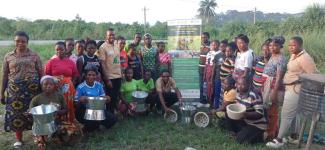
Suakoko District, Bong County, Liberia: Participants in an improved cookstove (ecostove) training programme in Suakoko District, Bong County, have praised Welthungerhilfe (WHH), the Sustainable Development Institute (SDI), and N'Gheleh Enterprise Incorporated for providing practical skills and new economic opportunities.
They also welcomed the programme’s promotion of cleaner cooking practices, which can help reduce pressure on local forests. The training is part of the “Community-Led Ecosystem Restoration in Farm-Forest Landscapes in Sierra Leone and Liberia” project. The project aims to improve natural resource management, restore degraded landscapes, and support community livelihoods through locally led environmental initiatives. Participants thanked the three organizations for introducing the ecostove initiative, describing it as a chance to gain useful skills, improve their economic prospects, and contribute to forest conservation.
For participants, the initiative is more than learning to make improved cookstoves. It offers a way to build livelihoods, strengthen their financial independence, and play an active role in protecting the forests and natural resources their communities rely on. Sarah Mulbah, a beneficiary from Kayata, Kporyorquelleh clan, said: “SDI and WHH trained us. They taught us how to make the ecostove. It cooks food in a short time. We used to spend LRD50.00 on coal for a regular coal pot, but now we can cook with LRD20.00 worth of coal.” Lucia Yarkpawolo, a resident of Gleanisiasue, also shared her experience: “Before we had the ecostove, we used to cook with wood, and the smoke made life very difficult for me. The ecostove is helping me. As you can see, we are now using palm kernel shell coal.”
At the same time, Francis Kerkulah, a resident of Kpatawee, praised SDI, WHH, and N’Gheleh Enterprise Inc. for training community members to use ecostoves. “It doesn’t use as much charcoal as an ordinary cooking pot. Since we received the training, each of us who took part from the different communities has been given a cookpot. We used to burn charcoal from the forest. If 99% of my people have access to an ecostove, our forest will be safe. We won’t need to burn charcoal from the forest anymore.”
The initiative also shows how community-based livelihood programs can support wider ecosystem restoration efforts. By introducing more efficient cooking technology, the project is helping communities find practical ways to rely less on forest resources while creating new opportunities to earn an income. With support from WHH, SDI, and N’Gheleh Enterprise Incorporated, the ecostove training contributes to the project’s broader goal: ensuring local communities not only take part in ecosystem restoration but also benefit from the economic opportunities created by sustainable environmental practices.
Mohammed Dunbar, Chief Operating Officer and Master Trainer at N’Gheleh Enterprise Inc., said with excitement, “This is one of the best opportunities we have had to work with SDI and WHH and make a difference in our communities. It means putting money in the pockets of project beneficiaries while helping to save the forest.”
According to Dunbar, the beneficiaries will be able to see their ecostoves, cook their food, and have something in their homes. He added, “They can also sell it to other residents and other community members to get energy and resources to take your children to school, take your children to hospital, and buy food for yourself and save something. And also, you are protecting the forest we are all trying to restore. So this is going to be a win-win for us. The reception has been very positive for us everywhere we went.”
The “Community-Led Ecosystem Restoration in Farm-Forest Landscapes in Sierra Leone and Liberia” project recognizes that lasting environmental restoration must go hand in hand with improved livelihoods, community ownership, and sustainable alternatives to activities that place pressure on natural resources.
This is N’Gheleh training summary: As community members put their newly acquired skills into practice, the initiative offers a promising example of how economic empowerment and environmental conservation can work together to support healthier forests and more resilient communities.
The Eco-Stove Fabrication and Charcoal Briquette Production Training Initiative across Suakoko, Kpatawee, and Kporyorquelleh clans has demonstrated that grassroots clean-cooking interventions can simultaneously advance environmental conservation, public health, and women’s economic empowerment. By mobilizing 30 rural communities, equipping 92 participants (including 62 women) with standardized technical and entrepreneurial skills, and delivering 93 energy-efficient Eco-Stoves directly into local households, the partnership with Sustainable Development Institute (SDI), Welthungerhilfe (WHH), and N'Gheleh Enterprise Incorporated has laid a replicable foundation for clean-energy transition in Bong County.
With strong endorsement from traditional authorities, active integration with Village Savings and Loans Associations (VSLAs), and growing commercial synergy between community artisan groups and N'Gheleh Enterprise’s Melekie processing facility, the trained cohorts are well positioned to operate sustainable, women-led green micro-enterprises that contribute meaningfully to Liberia’s 2030 NDC 3.0 clean-cooking targets.